

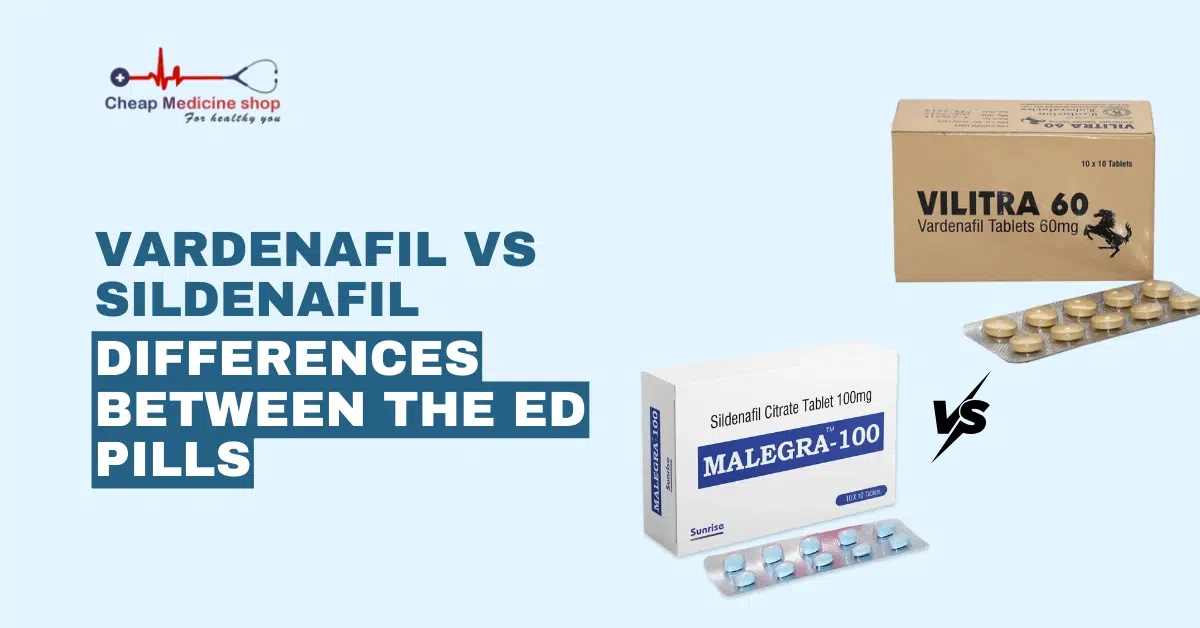
When it comes to Erectile Dysfunction (ED) treatment, oral pills are usually the first line of treatment, with Vardenafil and Sildenafil being two of the most commonly prescribed ED medications. They work by inhibiting an enzyme known as Phosphodiesterase Type 5 (PDE5). This mechanism helps relax blood vessels in the penis, improving blood flow during sexual stimulation and helping you achieve and maintain an erection.
However, they can differ in how quickly they start working, how long their effects last, the strengths available, and how they interact with food or alcohol. Sildenafil can last around 4 to 6 hours, whereas Vardenafil has a half-life of 4 to 5 hours, which can extend up to 8 hours in some cases.
If you are looking for quicker results, longer-lasting effects, or minimal risk of side effects, understanding the differences between them will help you to choose the best option based on your needs. This article compares the major differences in Vardenafil vs Sildenafil, helping you understand how each medication works and which one may be the better fit for you.
Vardenafil vs Sildenafil: Key Differences
Vardenafil and Sildenafil are both widely used PDE5 inhibitors for treating ED, but they differ in onset, duration, dosing, food interactions, and side effects. The following table highlights such key distinctions between these medications.
| Feature | Vardenafil | Sildenafil |
| Uses | Prescription-based medication for ED | Prescription-based medicine for ED and PAH |
| FDA-approval | Approved for ED in 2003 | Approved for ED in 1998 and for PAH in 2005 |
| Medicine class | PDE5 inhibitors | PDE5 inhibitors |
| Original Manufacturer | Bayer Pharmaceuticals | Pfizer |
| Appearance | Brand-form tablet is an orange, round-shaped tablet; generic versions can range from shades of orange to white, usually round-shaped | A blue, diamond-shaped tablet in its brand form; generics ranging from while to red with different shapes |
| Strength and dosage | Available in 5 mg, 10 mg, and 20 mg tablets. The usual starting dose is 10 mg | 20 mg, 25 mg, 50 mg, and 100 mg tablets. The usual starting dose is 50 mg for ED, and 20 mg (three times a day) for PAH |
| Brand-name | Levitra, Stanyx (ODT tablet) | Viagra, Revatio |
| Generic brands | Vilitra, Zhewitra, Filitra | Cenforce, Fildena, Suhagra |
| Onset of action | 25-60 minutes (often faster) | 30-60 minutes |
| Effect of food | Minimal impact | Fatty meals can have an impact on their effectiveness |
| Duration | Effects last for about 4-6 hours, possibly a little longer for some (up to 8 hours) | Effects last for about 4-6 hours |
| Side effects | Headache, hot flushes, upset stomach, stuffy/runny nose; lesser visual changes | Similar side effects, along with diarrhea, nosebleeds, and back pain |
Save up to 90% on your medicine bills
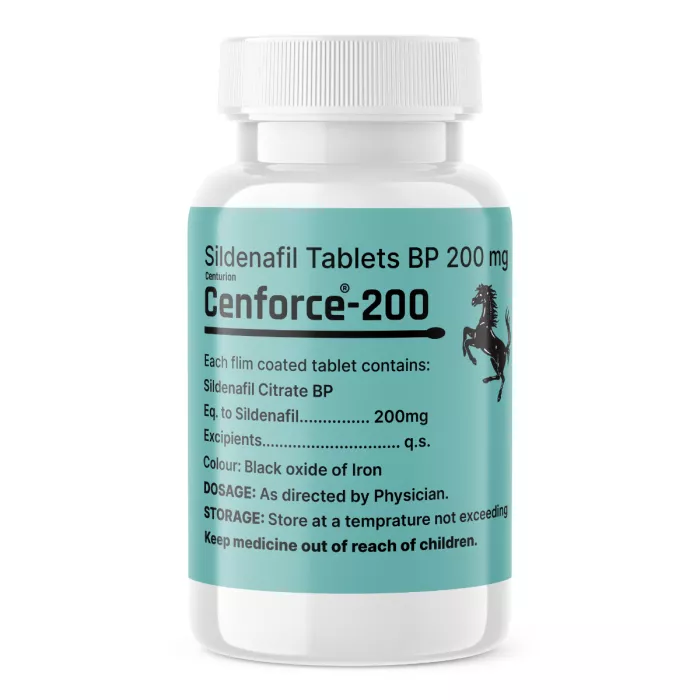
Cenforce 200 mg

Kamagra Oral Jelly Rx 100 mg
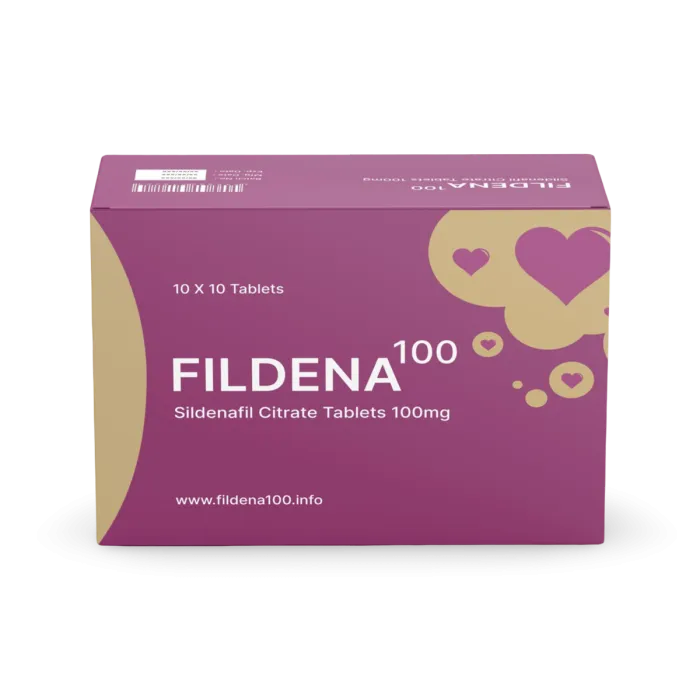
Fildena 100 mg

Vidalista 60 mg
Brands and legal status
Sildenafil and Vardenafil are both well-regulated prescription medications, and they’re available under multiple brand names as well as affordable generic versions across most countries.
- Sildenafil is best known for its brand-name Viagra, approved by the Food and Drug Administration (FDA) for ED in 1998 and later as Revatio in 2005 for Pulmonary Arterial Hypertension. Both of them are manufactured by Pfizer. It is also sold under generic versions of popular brands, including Cenforce, Suhagra, Caverta, Fildena, Silagra, and Kamagra. It holds FDA and European Medicines Agency (EMA) approval for ED and PAH.
- Vardenafil entered the market in 2003, approved by the FDA under the brand names Levitra and the orodispersible (tablet that dissolves without the need for water) Staxyn, with Bayer Pharmaceuticals as its manufacturer. Although Levitra has been discontinued in some regions, generic versions such as Vilitra and Zhewitra remain widely accessible. Vardenafil also holds FDA and EMA approval, specifically for the treatment of ED.
Both medications are effective for ED, but Sildenafil is more versatile since it also has approval for PAH, making it a suitable option if you need treatment for both conditions.
Appearance
Sildenafil and Vardenafil differ in their appearance, which can help you identify them easily.
- Sildenafil usually comes as a blue, diamond-shaped tablet in its brand form, Viagra, with “PFIZER” on one side and “VGR 25,” “VGR 50,” or “VGR 100” on the other. However, other manufacturing brands produce Sildenafil tablets in various colors, ranging from red, such as Cenforce 150 mg, to silver and shades of blue. It comes in different shapes, including round, oval, or diamond, as well as markings, depending on the manufacturer.
- Vardenafil is typically an orange or light yellow, round tablet in its brand form, Levitra. It features Bayer cross logo on one side and the dosage strengths (such as 2.5) on the other. Its generic brands vary from white to orange, usually round and biconvex, with imprints showing dosage and manufacturer codes. The orodispersible form, Staxyn, is a small, thin tablet that dissolves on your tongue without the need for water, adding convenience.
While both medications work similarly, their differences in color, shape, and tablet form can help you pick the version you prefer and easily identify your dose.
Strength and dosage
When it comes to dosing for ED, both medications are taken as needed about 30-60 minutes before sex, but their available strengths vary. Doctors may adjust either medication based on factors such as age, how well you respond, and any underlying health conditions, especially heart or liver issues. The differences in strengths are:
- Vardenafil is typically prescribed in 5 mg, 10 mg, or 20 mg doses, with 10 mg being the recommended starting dose by doctors. It is also available in an Oral Disintegrating Tablet (ODT) form, single strength of 10 mg, which dissolves on the tongue.
- Sildenafil typically comes in 20 mg, 25 mg, 50 mg, and 100 mg strengths, with 50 mg being the prescribed initial dose. For PAH, the standard dose recommended by a doctor is 20 mg three times a day.
Although both medicines offer flexible dosing for Erectile Dysfunction, Vardenafil’s ODT option provides added convenience, allowing for more personalized adjustments based on individual needs. Whereas Sildenafil’s PAH dosing approval makes it useful for patients who require treatment for both conditions under medical supervision.
Onset and duration
Sildenafil and Vardenafil differ slightly in how quickly they take effect and how long their effects last, which can impact your experience. The key difference is:
- Sildenafil typically starts working within 30-60 minutes after it is taken. Its effects last for about 4 to 6 hours, giving you a moderate window for sexual activity.
- Vardenafil can begin working slightly faster, often within 25-60 minutes, and in some cases, as early as 10 minutes. Its effects last up to 5 hours. A study published in European Urology in 2006 indicates that Vardenafil’s effects may last slightly longer, up to 8 hours, in certain cases.
If you prefer a faster-acting option with slightly longer-lasting effects, Vardenafil may be a better fit for you, though both medications are highly effective.
Effect of food
Sildenafil is sensitive to fatty meals. If you take it after a heavy meal, it may take longer to start working, and its effectiveness can be slightly reduced. For optimal results, you should take it on an empty stomach or avoid consuming very fatty foods for at least 2 hours before use.
Vardenafil is less affected by food, compared to Sildenafil. You can take it with or without meals without a significant change in onset or effectiveness. Its orodispersible version, Staxyn, is especially convenient because it can be taken without water and is minimally influenced by what you eat.
If you want more consistent and quicker results, Vardenafil may be slightly more flexible around meal times, while Sildenafil works best when taken on an empty stomach.
Side effects
Both Vardenafil and Sildenafil are generally well-tolerated when used as prescribed, but like all medications, they may cause side effects. Most are mild and temporary, though severe reactions are rare. Being aware of them can help you manage your experience safely.
Common side effects of both these ED pills are:
- Headache
- Flushing (redness or warmth in face, neck, or chest)
- Indigestion or upset stomach
- Nasal congestion
- Dizziness
Apart from these side effects, Sildenafil is more commonly associated with diarrhea, nosebleeds, and back pain compared to Vardenafil, where these side effects are less frequent.
Additionally, Sildenafil is more likely to cause visual disturbances, such as blurred vision, a blue tint, or increased sensitivity to light. These changes are usually temporary but can be noticeable, especially in low-light conditions. Vardenafil, on the other hand, tends to cause fewer visual issues, making it a potentially better choice if you are sensitive to vision-related side effects.
Precautions
While both Vardenafil and Sildenafil are generally safe when used as prescribed, there are some precautions you should be aware of. Here are some general precautions for both medications:
- Do not take either of the medicines if you are taking Nitrates (for chest pain) or certain blood pressure medications, as this can cause a dangerous drop in blood pressure.
- Avoid alcohol and grapefruit juice consumption, which can increase dizziness or lower effectiveness.
- Seek medical help immediately if you experience a prolonged erection, chest pain, or sudden vision or hearing loss.
- Let the doctor know if you have liver or kidney problems, Retinitis Pigmentosa (related to progressive vision loss), or a history of heart issues.
Conclusion
Both Vardenafil and Sildenafil are effective, well-regulated medications for treating Erectile Dysfunction, helping you achieve and maintain an erection by increasing blood flow to your penis. While they work in similar ways, they differ in onset, duration, dosage forms, and potential side effects.
Vardenafil offers a faster onset (within 25 minutes), a slightly longer duration, and fewer visual side effects, with an orodispersible option for added convenience. Sildenafil is also a highly effective ED medicine, but it is more likely to cause visual side effects. However, it offers a comparable 4-6 hour duration of action and is also FDA-approved for the treatment of Pulmonary Arterial Hypertension (PAH).
Ultimately, the best option between Vardenafil vs Sildenafil for you should be selected by a certified healthcare expert, based on your health, lifestyle, and personal preferences, to ensure both safety and effectiveness.

Frequently Asked Questions
Is Vardenafil stronger than Sildenafil?
Yes, Vardenafil is generally considered slightly more potent than Sildenafil on a milligram-to-milligram basis. This means it may work effectively at lower doses to achieve similar improvements in erectile function. Your doctor can help determine which medication and dose are best suited for you.
Can I take Sildenafil and Vardenafil together?
No, you should never take Sildenafil and Vardenafil at the same time. Combining them can dangerously lower your blood pressure, increase side effects like dizziness, headache, or fainting, and put excessive strain on your heart. Always use only one PDE5 inhibitor at a time under a doctor’s guidance.
Which ED medication has the fewest side effects?
Avanafil (Stendra) tends to cause fewer headaches, flushing, and nasal congestion than other oral ED medications. Vardenafil (Levitra) also has a relatively mild side effect profile, while Tadalafil (Cialis) is more prone to cause muscle or back pain. Individual responses vary, so consult your doctor for the best option.
What is the oldest age you can take Viagra?
There is no strict upper age limit for taking Viagra. It can be used safely by older adults, including those in their 70s or 80s, provided a doctor evaluates their overall health, heart condition, and other medications before prescribing it.
Cheap Medicine Shop only refers to credible, authoritative sources for our content. If you’re curious about how we ensure the integrity of our content, we encourage you to read our Content Information Policy.
Recent Web Stories