
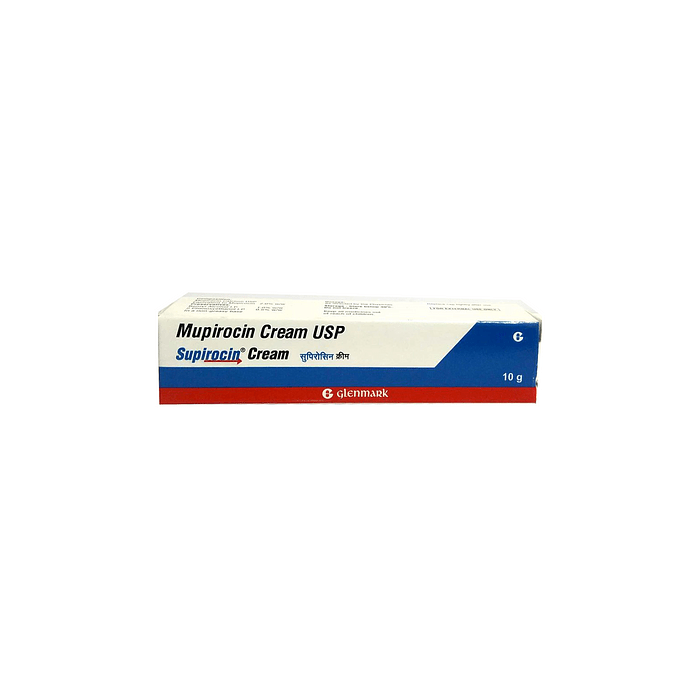
Supirocin Cream
Starting at just
$12.60
In stock
Only %1 left
SKU
CMS6989
Supirocin Cream is a topical antibiotic used to treat Impetigo, recurring boils, and other superficial infected lesions. It contains Mupirocin 2% and belongs to the Topical Bacterial Protein Synthesis Inhibitor class. Glenmark Pharmaceuticals Ltd. manufactures it in US FDA-inspected facilities.
Mupirocin works by stopping bacteria from making essential proteins. More specifically, it inhibits bacterial isoleucyl-transfer RNA synthetase, which interrupts protein and RNA synthesis. This helps clear skin infections caused by susceptible bacteria, especially Staphylococcus aureus and Streptococcus pyogenes.
Supirocin Cream is meant for external use only, and a thin layer is usually applied to the affected skin as directed by a dermatologist. Continue using it for the full advised course to ensure complete clearance of infection. If you miss a dose, apply it when you remember. Skip it if it is almost time for the next dose.
Minor burning, irritation, and rash can occur at the application site and often settle with use. Consult a doctor if these effects persist, if swelling or an allergy develops, or if the infection does not improve within 3-5 days. Avoid contact with your nose, mouth or eyes. Rinse with water and consult a doctor if accidental contact occurs.
Avoid using Supirocin Cream if you are allergic to Mupirocin, have chronic kidney disease or are using other topical medications. It should not be used for fungal infections, viral lesions or Acne without a bacterial cause. Pregnant or breastfeeding women and children should use it only under medical supervision.
Store the tube tightly closed below 25°C away from heat and moisture. Keep out of reach of children.
Supirocin Mupirocin Cream provides local antibacterial action for common superficial bacterial skin infections. Its main benefits and uses include:
Supirocin 2% Cream should be used at the prescribed dose and frequency. Typical instructions, however, are as follows:
Supirocin is available as a 10 g cream as well as a 5 g ointment. You can explore other Mupirocin topical substitutes offered by Medicine Shop below:
| Mupitoz Cream 10 g | $ 2.86/1 tube |
| Mupifon 2% Cream | $ 3.22/1 tube |
| Mupinase 7.5 g Cream | $ 7.31/1 tube |
Supirocin 2% Cream is usually well-tolerated when used on a small infected area. The common side effects are mild and limited to the application site, such as:
These are mostly temporary and improve as the skin responds to treatment. Stop using it and consult your dermatologist if they persist, worsen, or you notice signs of allergy.
 Liver Disease
Supirocin Cream acts locally on the skin, and absorption into the bloodstream is minimal. Dose adjustment is generally not required in liver disease.
 Kidney Impairment
Mupirocin absorption through intact skin is low, but caution is advised in severe kidney impairment when treating large areas for prolonged periods.
 Pregnant and Breastfeeding women
Pregnant and breastfeeding women should consult their doctor before using Supirocin Cream. Even though drug exposure is limited, medical supervision is recommended.
 Avoid
Avoid
Avoid using Supirocin Cream if you are allergic to Mupirocin or any ingredient in the cream. Do not use it in the eyes, nose, mouth, private parts or large damaged skin areas. Never combine it with other topical medicines on the same area, without medical advice, as this may increase absorption or irritation.
Supirocin Cream is used to treat bacterial skin infections such as Impetigo, recurring boils, and other superficial infected lesions. It contains Mupirocin 2% (w/w), which helps stop the growth of susceptible bacteria on the skin.
No, you should not use Supirocin Cream for Acne or pimples unless a dermatologist confirms a bacterial component. Acne often has a different cause and requires treatment with Benzoyl Peroxide or Clindamycin.
No, Mupirocin should not be applied to the private parts unless a dermatologist specifically advises it. It should not be applied to sensitive skin to avoid irritation or worsening of symptoms. Also, avoid contact with mucosal areas, such as the eyes, nose and mouth.
Supirocin Cream can start improving infection symptoms within 3 to 5 days. However, you should still complete the prescribed course so the infection clears properly and is less likely to come back.
Yes, topical Mupirocin cream is generally considered safe for babies aged 3 months and older when prescribed. Infants should be evaluated by a dermatologist or pediatrician first, especially if the rash is widespread or not clearly bacterial.
You should stop using Mupirocin cream after completing the prescribed course, which is typically 10 days. Stop use earlier if severe irritation, allergy, or worsening infection appears and contact your doctor promptly.
Yes, Mupirocin antibiotic cream can be used on superficial infected wounds, cuts or lesions. However, it should not be used on deep open wounds, major burns, or severely damaged skin without medical evaluation.
You should avoid using Supirocin Cream if there is a known allergy to Mupirocin or if the skin problem is fungal or viral. You should never use it on areas involve the eyes, mouth, nose, or private parts. Pregnant or breastfeeding women and those with severe kidney impairment should avoid use unless clearly prescribed.