
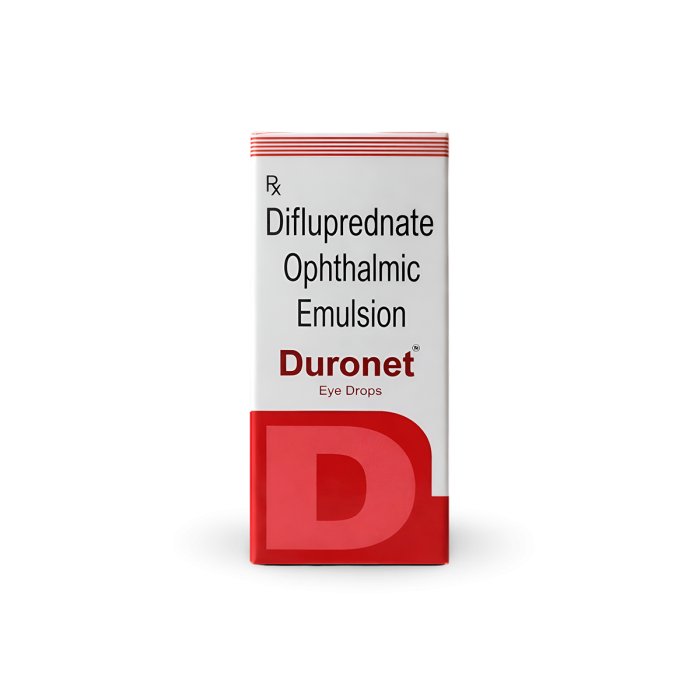
Duronet 5 ml
Starting at just
$19.10
In stock
Only %1 left
SKU
CMS1913
Duronet 5 ml Eye Drop is a topical corticosteroid ophthalmic emulsion used to treat eye inflammation, especially after surgery. Its active ingredient is Difluprednate 0.05% (w/v), which belongs to the topical glucocorticoids class. It is manufactured by Sunways India Pvt. Ltd. in WHO-GMP-compliant facilities.
Difluprednate eye suspension is a potent steroid that inhibits inflammatory mediators in ocular tissues. This action helps reduce swelling, redness, pain, and corneal haze associated with surgical eye inflammation or immune-related eye disorders. It also contains Sorbic acid 0.1% (w/v) as a preservative to maintain sterility of the formulation and prevent microbial growth.
Duronet 5 ml drops are commonly prescribed after Cataract surgery or for inflammatory eye conditions such as Uveitis and Iritis. The usual dosage is 1 drop in the affected eye 4 times daily for 14 days, beginning 24 hours after surgery. It is then tapered to 2 times daily for 1 week and then weaned off as advised by an ophthalmologist.
To improve absorption, press the inner corner of the eye for 1 minute after applying the drop. Wait 5-10 minutes between other medications and Duronet to prevent dilution and maintain treatment effectiveness. Avoid wearing contact lenses during treatment.
Common side effects of Duronet 0.05% (w/v) 5 ml eye drops include temporary blurred vision, eye irritation and burning sensation. However, seek immediate medical advice if you experience persistent eye pain, redness, vision changes, or corneal issues.
Prolonged use of Duronet eye drops can increase the risk of infection or delayed healing. Thus, those with existing corneal conditions, active eye infections, or Glaucoma should consult their doctor. Use during pregnancy, breastfeeding, or in children requires medical supervision.
Store Duronet 5 ml below 25°C in a cool place away from heat and sunlight. Keep it out of reach of children.
The active ingredient, Difluprednate, received FDA approval in 2008 for the management of eye inflammation and pain following ocular surgery. The key benefits and uses of Duronet 5 ml Eye Drops include:
Use Duronet 5 ml eye drops exactly as prescribed by your ophthalmologist. The general application steps include:
Duronet is currently available as Difluprednate 0.05% (w/v) 5 ml eye drop only. We offer other substitutes at affordable prices, including:
| Optipred 5 ml | $ 4.01/1 bottle |
| Diflucor 5 ml | $ 5.47/1 bottle |
| Uvefrost 5 ml | $ 4.53/1 bottle |
Duronet 5 ml eye drops may cause certain mild side effects following instillation, including:
These side effects are mostly short-lived and resolve on their own. In rare cases, prolonged use can increase Intraocular Pressure (IOP) and thus, the risk of Glaucoma, Cataract formation, or secondary eye infections. If you experience persistent irritation, severe eye pain, swelling, or vision changes, discontinue use and consult your ophthalmologist immediately.
 Liver Disease
Duronet Eye Drops act locally on the eye surface and have minimal absorption into the bloodstream. Therefore, dose adjustment is generally not required in patients with liver disease.
 Kidney Impairment
Difluprednate ophthalmic drops are not significantly absorbed systemically. Hence, Duronet 5 ml can be used safely in patients with kidney impairment under medical supervision.
 Pregnant and Breastfeeding women
Limited data is available regarding the use of Difluprednate during pregnancy and breastfeeding. Therefore, Duronet Eye Drops should be used only if prescribed by a doctor.
 Avoid
Avoid
Avoid using Duronet 5 ml Eye Drops if you are allergic to Difluprednate or Sorbic acid. Patients with Corneal Ulcers or Herpes Simplex eye infection should consult an ophthalmologist before use. Regular monitoring of intraocular pressure is recommended with prolonged use to prevent Glaucoma or peripheral vision loss.
You can use 1 Duronet eye drop in the affected eye 4 times daily for the first 2 weeks post-surgery, starting 24 hours after surgery. The dosage is typically reduced to twice daily for one week and gradually tapered off. Follow the dosing schedule as advised by your ophthalmologist.
You should use Duronet Eye Drops only for the duration prescribed by your doctor, typically 4-6 weeks. Since prolonged use can increase the risk of elevated eye pressure, treatment duration should always be monitored by an ophthalmologist.
Inform your doctor if you have Glaucoma, corneal damage, eye ulcers, Herpes simplex eye infection, or a pus-filled eye infection. You should also let your doctor know if you are pregnant, planning to conceive or breastfeeding before starting Duronet Eye Drops.
No, Difluprednate is not the same as Prednisone, even though both are corticosteroids. Difluorinated Prednisolone Butyrate Acetate is optimized for ocular use with higher potency. On the other hand, Prednisone (converted to Prednisolone) is preferred as an oral corticosteroid for treating inflammation in various parts of the body.
Do not touch the dropper tip to your eye, eyelids or other surfaces to prevent contamination. Remove contact lenses before applying Duronet Eye Drops and wait 15 minutes before reinserting them. Caution is also advised during pregnancy, nursing, pediatric or long-term use.
No, you should not use Duronet Eye Drops with other corticosteroid eye medications, as this combination can elevate intraocular pressure, Glaucoma or infections. Medicines like cyclosporine or other immunosuppressants may also increase your risk of infection, so consult your doctor before combining treatments.
Yes, Duronet Eye Drop is safe for children over 1 year old for short-term post-surgical inflammation, but only under medical supervision. Use in infants should be avoided due to the risk of Glaucoma. Always consult a pediatric ophthalmologist before use.
To support quicker recovery after Cataract surgery, follow all post-operative care instructions carefully. Avoid dust and environmental pollutants that may irritate the eyes. Eat foods rich in vitamins A, C, and E, and include minerals such as zinc and copper in your diet to support eye health.